
Little Monsters on the Boat
Cockroach Alert on the Amira: The Battle Against American Cockroaches Begins
By Renate Rüger, May 17, 2026
Bluewater sailing is repairing boats at the most beautiful anchorages in the world, as they say. The Cayos Cochinos are such a place. But here we’re not repairing our Amira—because we’re missing the spare parts. Instead of the anchor light we lost on the rough passage to Mexico, we let the navigation light shine, and instead of the leaking toilet in our cabin, we use the guest toilet in the opposite hull (a luxury not everyone has!). But here, at one of the most beautiful anchorages in the world, we’re fighting some of the fastest animals in the world, at least relative to their body size: cockroaches. The little creatures can reach five kilometers per hour, which is about 40 to 50 body lengths per second—far more than a cheetah, which manages 15 to 20 body lengths per second.
They’re fast, these roaches. I first discover one among the forks in the drawer next to the sink. A baby cockroach, darker and rounder than its parents. And it’s already gone. Is that a beetle or a cockroach? Then the next day, the second and third. And suddenly a small, lighter and more elongated creature on the wooden cutting board. Now I empty everything, the entire storage space under the sink. Small black crumbs reminiscent of coffee grounds on the wooden edge—clear traces of cockroaches. Here among all the cleaning supplies and laundry detergent! I quickly wipe everything clean with vinegar in the dishwater and spray all corners and openings with anti-cockroach gel.
Where Are the Cockroaches Hiding?
Now the wall cabinet with all the spices, the cabinet with flour, coffee, lentils and other supplies, the next cabinet—everything emptied, checked and wiped down with vinegar again just to be safe. The shelf, the toaster. Damn, there are of course lots of crumbs in there—a nice meal for the cockroaches! The strange thing is: I don’t find any traces of the crawling creatures anywhere here. Where are the animals coming from? Where is the nest? Where are they reproducing? I rage in a cleaning frenzy, look again in the storage space under the sink. There, a reddish-brown cockroach by the drain pipe. Wham! I actually got it with the wooden cooking spoon and killed it. Now I go down the stairs into the port hull, unscrew the wall covering behind which the wastewater pipe continues and where the water pump sits. A single dead cockroach lies there with its feet up, right next to the pipe. Has it already tasted the gel? There are holes, niches, cracks everywhere in the boat, the cockroaches can go everywhere. Everywhere we can’t reach. Where are they hiding?
A cockroach can live for weeks on a postage stamp, I once read in an article that really impressed me. Well, those stamps with starchy adhesive for moistening hardly exist anymore, so it must have been a long time ago that I read that. Without water, cockroaches couldn’t survive long on a postage stamp either. But as an image of how frugal a cockroach is, the postage stamp works well. Hair, paper and cardboard, leather, toothpaste or soap: cockroaches go after all of this if they don’t find food. In other words: we can keep the pantry as clean as we want, we don’t stand a chance against cockroaches. Most bluewater sailors have had the creatures on board at some point, especially since some cockroach species can also fly. The question of where the animals come from and why they chose our Amira of all boats is therefore pointless.
Good thing we’ve packed most of our supplies in glass or additionally in plastic bags and removed the labels from cans. But that doesn’t help us much now, any more than the cleaning does. The syringe with the anti-cockroach gel is running out. We need supplies, so after Cayos Cochinos we head back to Utila. There we buy a larger syringe of gel with the nerve poison fipronil. Again I spray all the places where we’ve spotted animals. After two days, no more roaches are visible. The nightmare is over, we think. But the next day, two cockroaches scurry back and forth in the cabinet under the sink and three in the compartment under the stove. It takes almost a whole week before there’s actually peace.
Of course, the poison in the gel, which supposedly smells good to roaches, doesn’t work immediately. And that’s a good thing, because the roaches are supposed to eat it and run back to their hiding place before they die. Other roaches will then attack them there. Because they not only eat the feces of their fellow roaches, but also their fellow roaches themselves and thus the poison that killed them. A domino effect that should ultimately send all roaches to their eternal hunting grounds. That’s the theory.
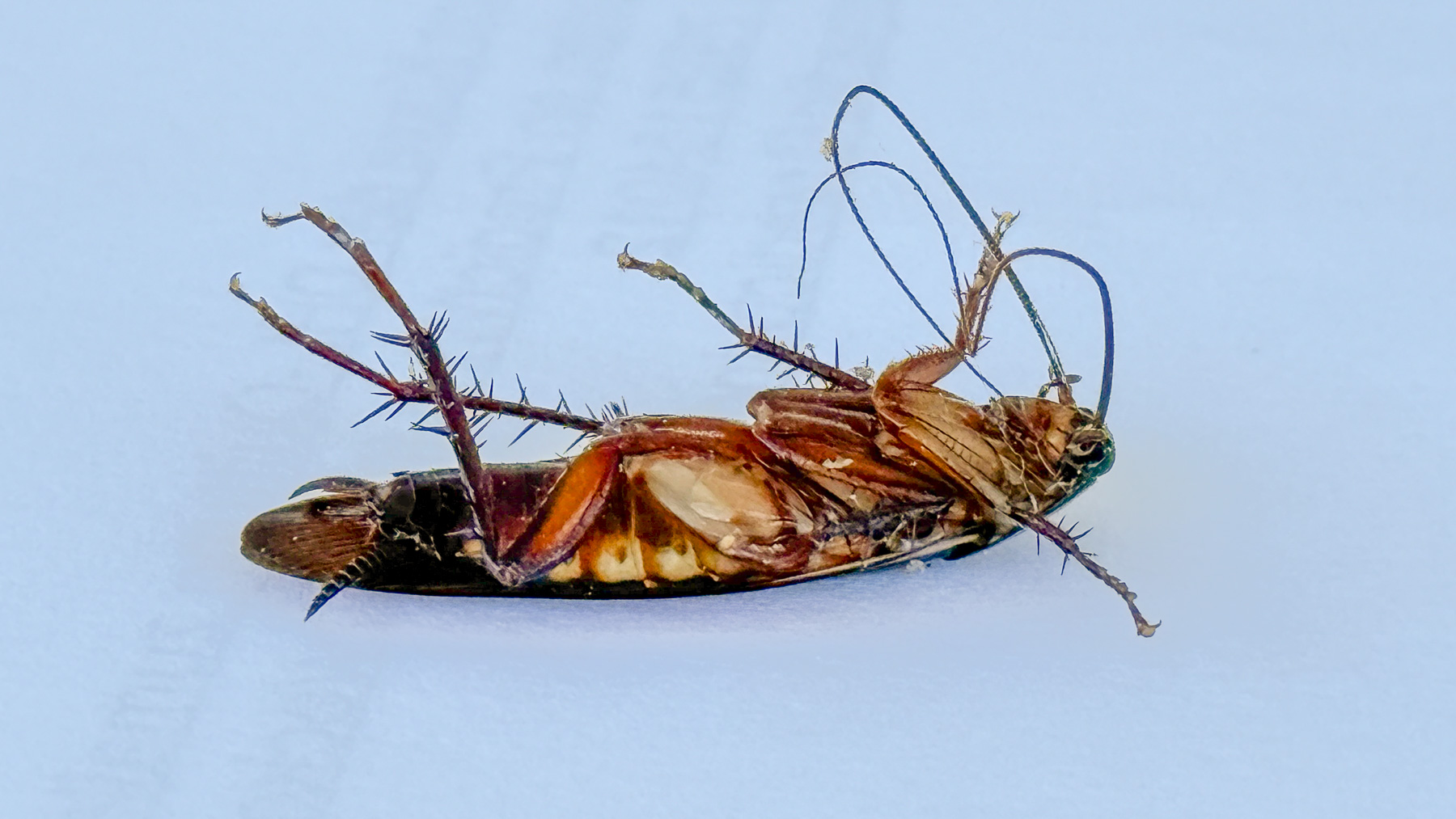
The peace we enjoy for three days is deceptive. A baby cockroach that crawls toward me the following night, I crush immediately. Its presumed mother (at least judging by size) initially flees into a gap. Now this roach stretches its long antennae upward. Is it trying to scout whether the coast is clear? The light, which cockroaches so much avoid, is still on. The roach nevertheless bravely starts to run, races to the drain pipe and escapes through the hose opening in the cabinet. I quickly run to the port hull, shine a spotlight on the space by the water pump and flinch abruptly. There’s a really big cockroach lying on its back! I can’t reach far enough with my arm to pull it closer and examine it. Tomorrow, I think, and close the hatch. The huge cockroach is dead anyway, I’ll take a closer look at it tomorrow.
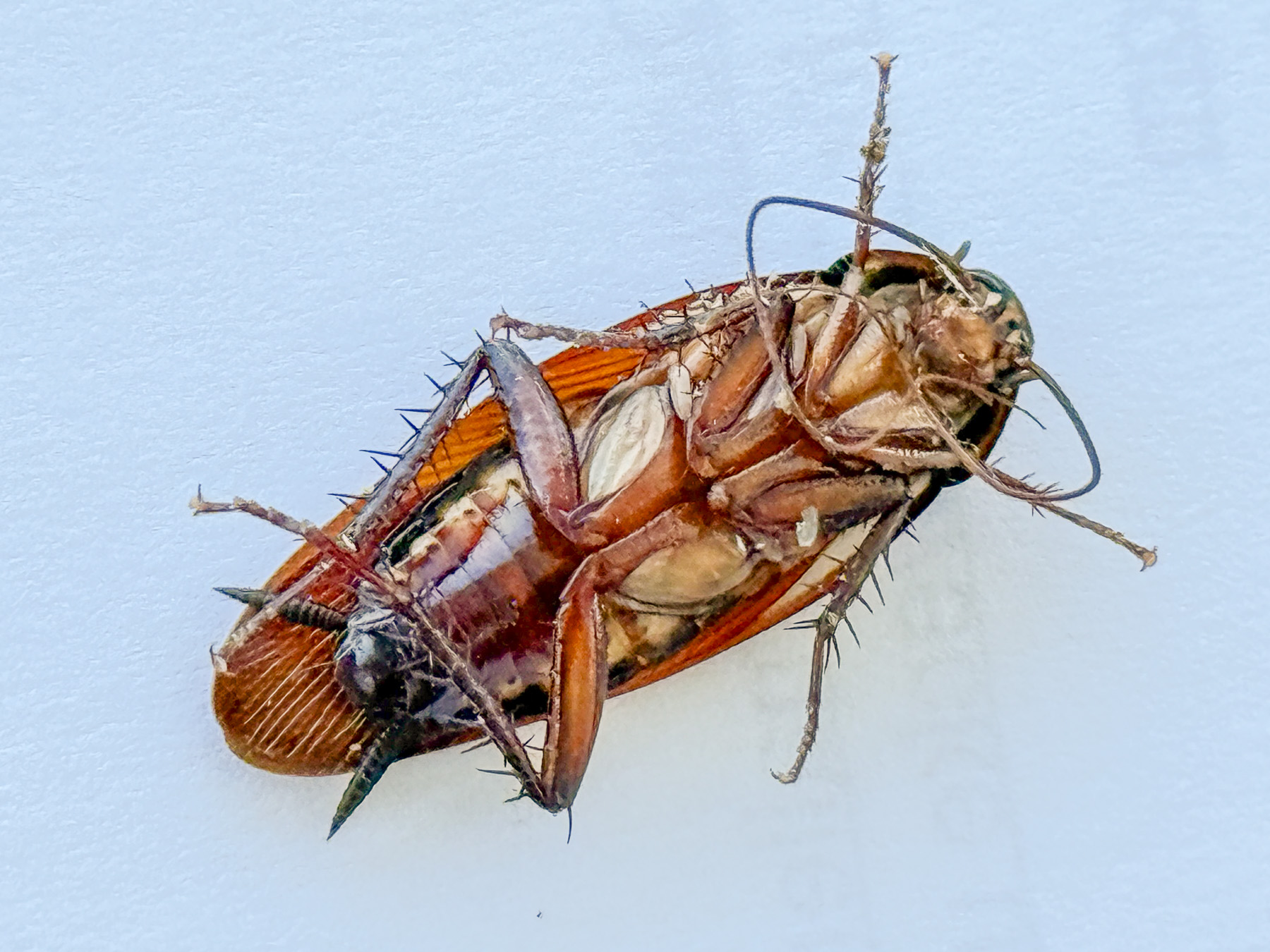
With barbecue tongs, I carefully pull the roughly five-centimeter roach out of the gap by the water pump the next day and place it on a sheet of paper to take a photo. Planned caption: On its back with all legs stretched out, the cockroach is dead. Suddenly a leg moves, the cockroach slowly pulls it back and forth, as if it wants to do gymnastics. Am I seeing correctly or am I dreaming? Is the animal still alive or is it just some kind of reflex? I turn the roach over, now it actually seems to want to walk. Thump! I strike, with a spoon on the head, knowing full well that a cockroach can live eight days without a head.
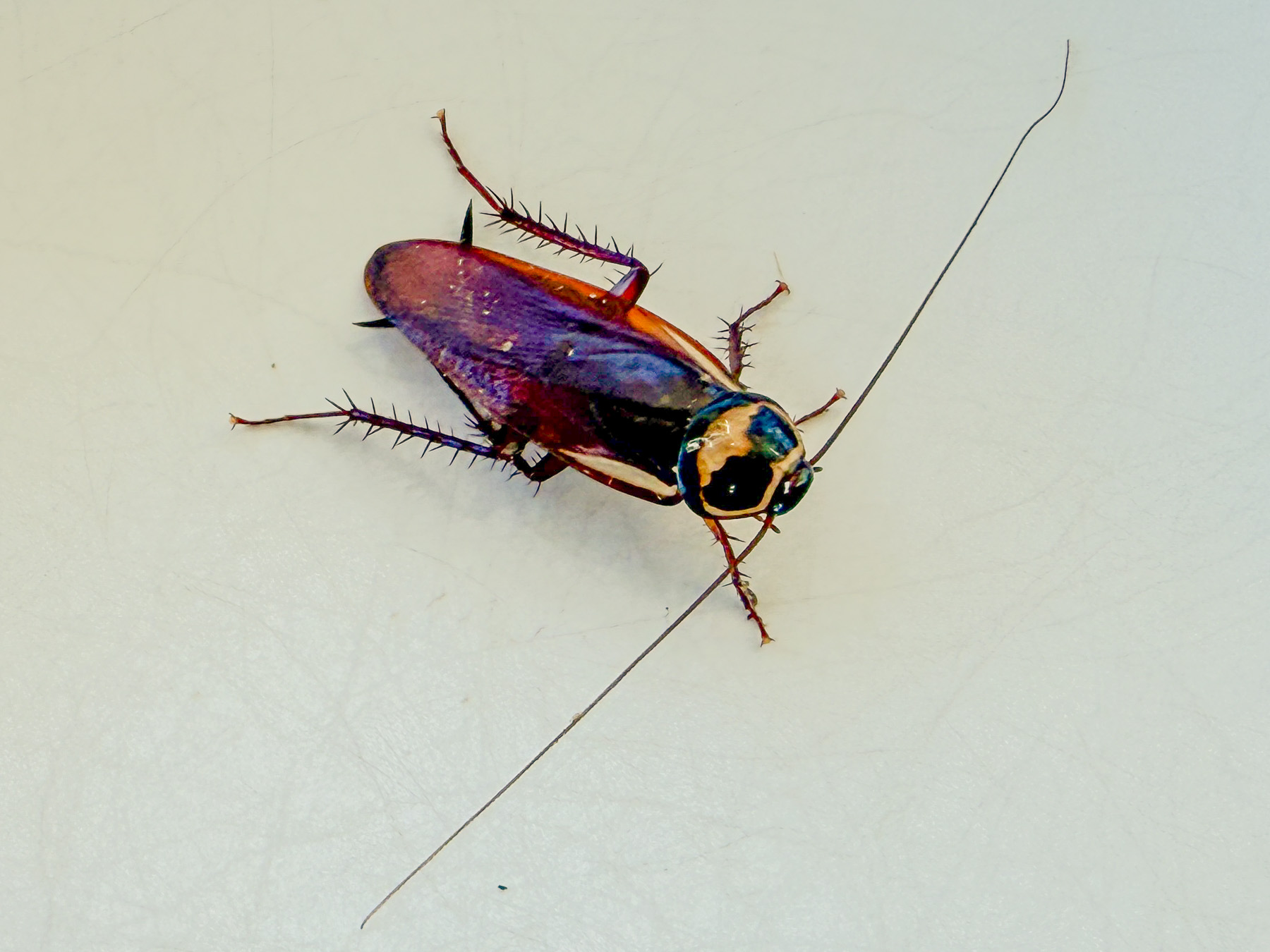
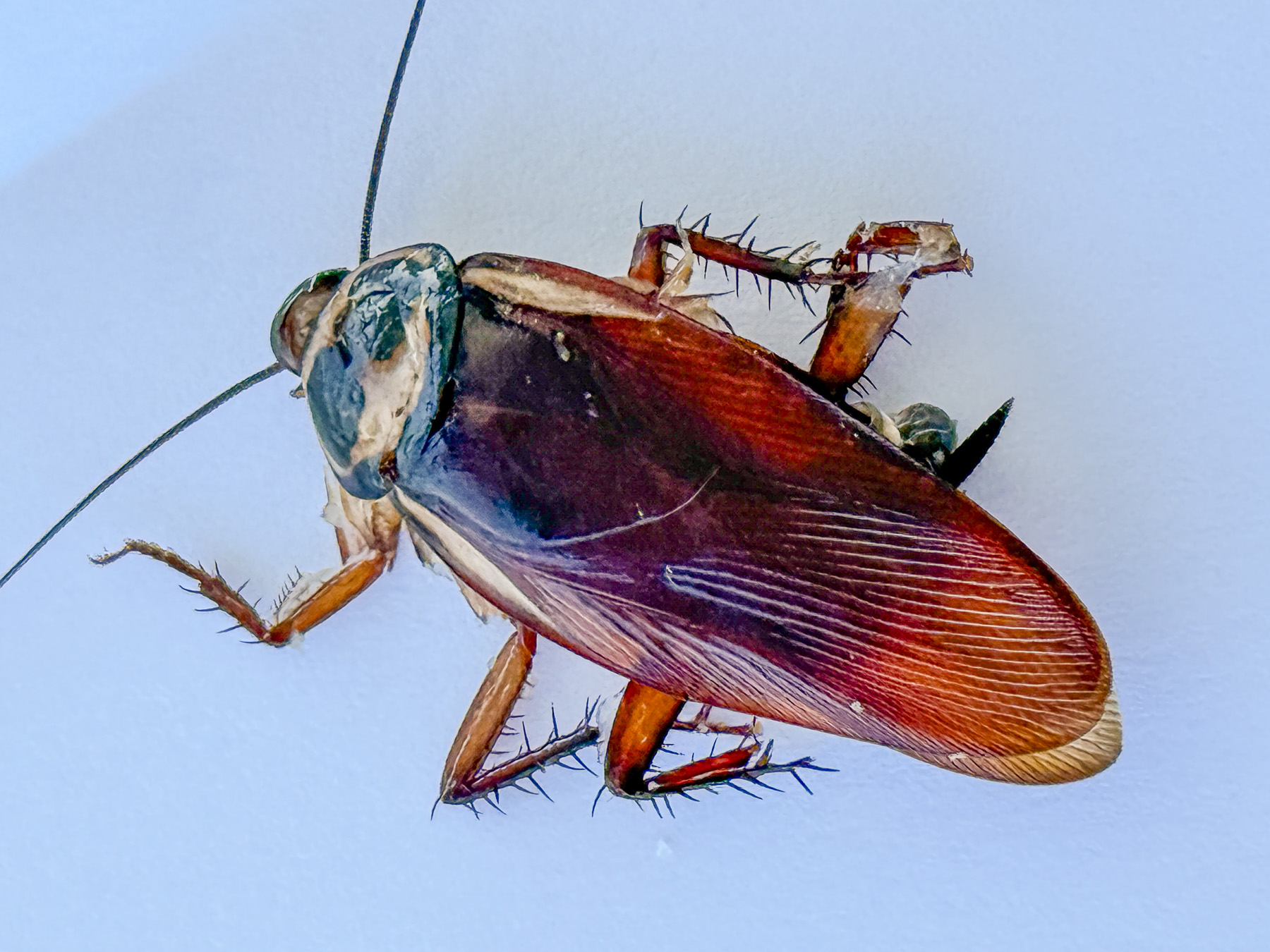
It’s the American cockroach, as I can easily tell by the pale yellowish pronotum. So we have these cockroaches, which are particularly large and can fly. “Their legs can still move uncontrollably for hours after death—or even for days under cool conditions—or react to touch,” I read from the AI assistant Gemini, which refers to the pest control company Anticimex. The reasons given are the decentralized nervous system of the roaches, the extremely sensitive sensory hairs, and the effect of the poison, which blocks nerve signal transmission, leading to permanent, uncontrolled muscle spasms.
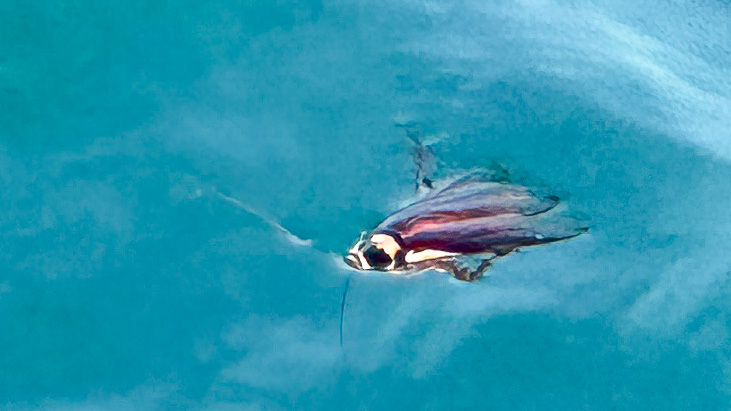
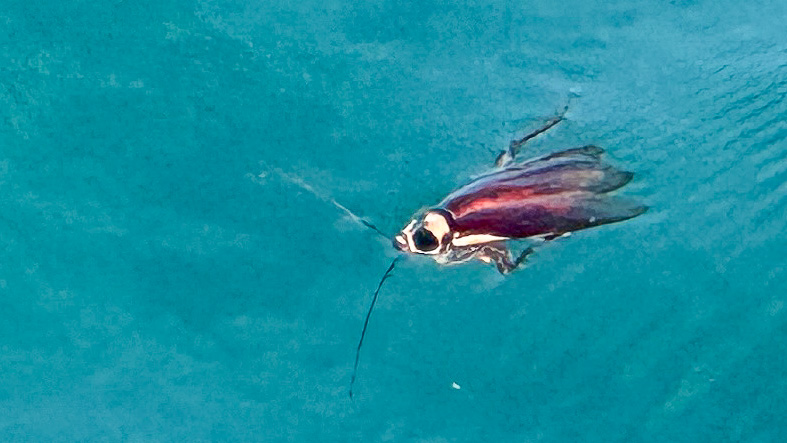
The whole thing makes me uneasy. “Throw the cockroach in the sea!” says Peter. He doesn’t want to see the creature anymore. I throw the roach into the water, into the turquoise sea, which is quite calm right now. The lifeless body moves up and down. I take a photo. Magnified, the cockroach now looks like an eerie creature with a pale head and large eyes. The long antennae seem to be scouting the direction. And there: the legs move as if the roach wants to swim back to the Amira. The waves, however, drive it out to the open sea.
Oh, if only we were rid of all the American cockroaches on the boat! The problem is the eggs. The female cockroaches lay them in protected places in solid egg capsules (oothecae) that the poison gel cannot penetrate. Even if all the cockroaches on the Amira were dead, new ones could still hatch—between 15 and 20 nymphs per egg packet, as the young are called. They first have to come out by our sink or the stove, find the gel, eat it and die. So we’ll only be certain in the end if we don’t find any roaches even in three months. In the worst case, we’ll have to get an exterminator to fumigate the boat.
Update, June 1, 2026:
The cockroaches have disappeared. We hope, anyway. The last one we saw was already moving damn slowly in the spotlight—a sign that it already had poison in its body. Since then there’s been real peace and we’ve put the cabinets back in order. Check-up is in a month—just in case a roach has hidden an egg packet somewhere from which up to 16 young roaches could hatch. But what if several roaches have glued several egg packets into some cracks? At 30 degrees the larvae are supposed to be ready after just five weeks, and here it’s well over 30 degrees… No, no, we don’t want to think about such things.


